 MepcoOnlineBill
This page explains exactly what FPA is, how it is calculated, why it changes every month, and what you can do about it.
What Does FPA Mean on My Electricity Bill?
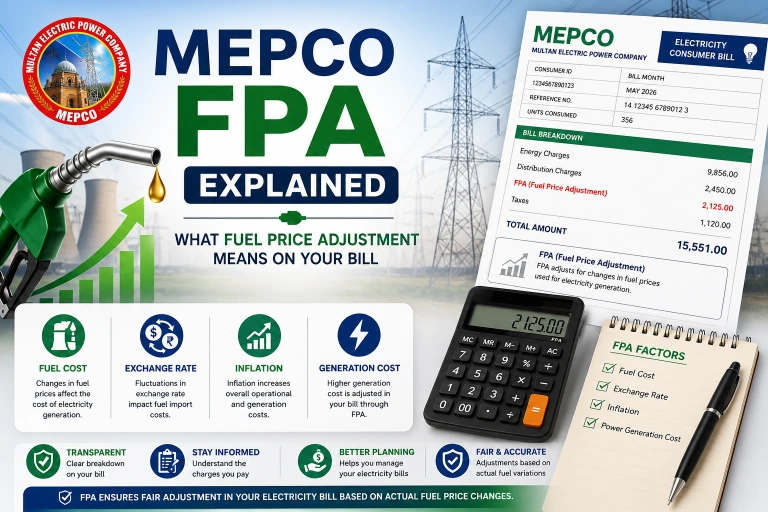
FPA stands for Fuel Price Adjustment. It is a monthly surcharge added to your electricity bill to cover the difference between what it actually cost to generate electricity that month and the reference fuel cost already built into your base tariff.
In simple terms: when the government set your per-unit electricity rate, it assumed a certain fuel cost. When actual fuel costs in the power sector go higher than that assumption, the extra amount is passed on to you as a positive FPA. When fuel costs come in lower, FPA can be negative — meaning a small reduction in your bill.
NEPRA (National Electric Power Regulatory Authority) calculates and announces the FPA every month. You have no control over it, and it applies to every electricity consumer in Pakistan.
How is FPA Calculated?
FPA is calculated per unit (kWh) consumed. The formula NEPRA uses:
FPA = (Actual Fuel Cost per kWh) − (Reference Fuel Cost per kWh)
This difference, whether positive or negative, is then multiplied by the number of units you consumed that month.
Example from January 2026:
- NEPRA announced FPA: Rs. 1.63 per unit
- A household that consumed 300 units that month paid: 300 × Rs. 1.63 = Rs. 489 extra
- A household consuming 500 units paid: 500 × Rs. 1.63 = Rs. 815 extra
The FPA amount is printed as a separate line item on your bill — look for "Fuel Price Adjustment" or "FPA" in the charges section.
Why Does FPA Change Every Month?
Pakistan's power sector uses multiple fuel sources to generate electricity:
- Hydro: WAPDA dams — cheapest fuel, but dependent on rainfall and dam levels
- LNG (Liquefied Natural Gas): Imported, priced in USD, expensive
- Furnace oil: Thermal plants, highly sensitive to global oil prices
- Coal: Imported from South Africa and Indonesia, priced in USD
- Nuclear: PAEC plants, relatively stable cost
The mix of these sources changes every month depending on dam water availability, import prices, and plant availability. When hydro generation is high (typically July to September, monsoon season), FPA tends to be lower because cheap water replaces expensive thermal generation.
When dam levels are low — especially in April, May, and June before the monsoon — more thermal power plants run, burning expensive LNG and furnace oil. Fuel costs spike. FPA spikes. Your bill spikes.
This is the single biggest reason why South Punjab households see their July or August bill 30 to 40 percent higher than their December or January bill, even with similar usage.
FPA vs Your Base Tariff — What is the Difference?
Your base tariff (the per-unit rate you see in the tariff slab table) is set once a year by NEPRA and is meant to stay stable. It assumes a "reference fuel cost" — an average expected cost of generating one unit of electricity.
FPA is the monthly correction. It bridges the gap between that assumed reference cost and reality.
Think of it this way: your tariff slab is the salary, and FPA is the overtime — positive when fuel costs run hot, occasionally negative when they cool down.
Both are separate line items on your bill. Your energy charge (from the tariff slab) is calculated first, then FPA is added on top, before GST is applied to everything.
FPA History — Recent Months
| Month | FPA Rate (per unit) | Direction |
|---|---|---|
| January 2026 | Rs. 1.63 | Positive (added to bill) |
| December 2025 | Rs. 0.98 | Positive |
| November 2025 | Rs. 1.12 | Positive |
| October 2025 | Rs. −0.43 | Negative (reduced bill) |
| September 2025 | Rs. 2.18 | Positive (monsoon end, hydro dropping) |
| August 2025 | Rs. 1.87 | Positive |
| July 2025 | Rs. 0.72 | Lower (peak monsoon hydro) |
FPA is highest in the hot pre-monsoon months (April to June) and lowest during peak monsoon hydro generation (July to September). December and January tend to be moderate.
Is FPA Legal? Can I Dispute It?
FPA is legally authorized under the NEPRA Act and the terms of your electricity connection. It is not unique to the company — every DISCO in Pakistan applies it.
NEPRA publishes the monthly FPA determination in the official gazette and on its website (nepra.org.pk). The decision includes a full breakdown of fuel costs, generation mix, and the mathematical basis for the adjustment. It is not something the electricity company decides — it is a regulatory order.
You cannot dispute FPA itself. However, if you believe the FPA on your bill is different from what NEPRA announced for that month, that is worth verifying. Compare the per-unit FPA on your bill with the NEPRA announcement for your billing period. If they do not match, file a complaint through the CCMS portal.
How FPA Affects Domestic vs Commercial Consumers
FPA applies equally per unit to all consumer categories — domestic, commercial, industrial, and agricultural connections all pay the same FPA rate per unit consumed.
However, the impact feels larger for commercial and industrial consumers because:
- They consume far more units monthly
- Their bills are already higher from MDI charges
- GST at 18% is applied after FPA is added, so the tax multiplier amplifies FPA's effect
For a domestic household consuming 300 units, Rs. 1.63/unit FPA means Rs. 489 extra before GST. After 18% GST on the total bill, the effective FPA impact on total payable is actually closer to Rs. 578.
What Can You Do About FPA?
You cannot remove FPA. But you can reduce how much you pay:
Use less electricity. FPA is charged per unit. Every unit you save reduces the FPA you pay proportionally.
Shift consumption to off-peak hours. This does not directly reduce FPA, but using ACs and heavy appliances at night (11 PM to 7 AM) keeps your total consumption lower and avoids the peak demand MDI charge for commercial users.
Stay below 200 kWh. Protected consumers pay FPA on fewer units and at a lower base cost, meaning the total bill impact of FPA is much smaller.
Solar net metering. Under the December 2025 net billing policy, solar generation you export to the grid is credited against your consumption. Lower net consumption means lower FPA. Read the full net metering 2026 guide.
Monitor monthly. Since FPA changes every month, check this page for the latest rate before your billing cycle ends. If this month's FPA is particularly high, reducing consumption even slightly in the last few days of the cycle reduces your FPA charge noticeably.
FPA on My Bill Shows a Negative Number — What Does That Mean?
A negative FPA is good news — it means actual fuel costs came in below the reference price built into your tariff, and NEPRA is passing the savings to you.
For example, if FPA is −Rs. 0.43/unit and you consumed 250 units, your bill is reduced by Rs. 107.50 before GST. This does not happen often, but it did occur in October 2025.
On your printed bill, a negative FPA appears as a negative figure in the FPA row. Your total payable amount will be slightly lower than a calculation based on energy charges alone would suggest.
Frequently Asked Questions — FPA
What does FPA stand for on an electricity bill?
FPA stands for Fuel Price Adjustment. It is a monthly per-unit charge determined by NEPRA to cover the difference between actual electricity generation fuel costs and the reference cost built into your base tariff.
Why is FPA different every month?
Because electricity generation fuel costs — LNG, furnace oil, coal, and hydro availability — change every month based on global commodity prices, dam water levels, and the power generation mix. NEPRA recalculates and announces a new FPA rate each month.
Is FPA part of the base electricity rate?
No. FPA is a separate line item added on top of your energy charges (the slab-based tariff). It appears as its own row in the charges section of your bill.
Can FPA be negative?
Yes. When actual fuel costs are lower than the reference price, NEPRA announces a negative FPA, which reduces your bill slightly. This is uncommon but happens occasionally, usually during high hydro months.
Does GST apply on FPA?
Yes. GST at 18% is applied to the total of energy charges plus FPA plus FC Surcharge. This means FPA effectively costs you more than its face value after tax is added.
Which months have the highest FPA?
Historically, April, May, and June see the highest FPA in Pakistan because dam levels are at their lowest before the monsoon, forcing more expensive thermal generation. July through September typically see lower FPA as hydro generation peaks.
Is FPA the same for all electricity companies in Pakistan?
NEPRA announces one national FPA rate that applies across all DISCOs — MEPCO, LESCO, IESCO, PESCO, and others. The per-unit amount is the same regardless of which distribution company serves your area.
Can I get a refund if FPA was charged incorrectly on my bill?
If the FPA rate on your bill differs from what NEPRA officially announced for that billing period, you have grounds to file a correction complaint. Contact the helpline or file through the CCMS portal. Verified discrepancies result in adjustment in the next month's bill.
Last updated: August 2026 | FPA rates sourced from NEPRA official determinations
Bill calculator with FPA · Full bill charges explained · Tariff rates 2026 · File a complaint