 Billonlinemepco
The Two Sides of Your Electricity Bill
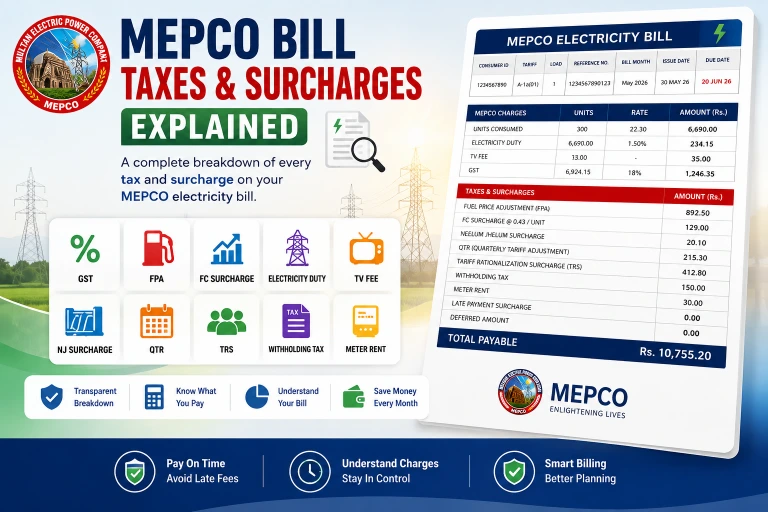
A standard South Punjab electricity bill has two sections: the payment stub (the part you hand over at the bank or scan at an ATM) and the detail section (the full breakdown of charges). Most confusion comes from people only ever looking at the payment stub.
The detail section lists every charge individually. Here is what each one means.
How Your Electricity Bill Is Generated — The 6-Step Process
Most people treat their electricity bill as something that simply arrives each month, without understanding the process that produces it. Knowing these steps helps you identify exactly where an error can enter the system — which makes billing complaints faster and more specific.
Step 1 — Meter reading. A field reader visits your premises and records your meter's present reading. In areas with AMI (smart) meters, this happens remotely without a physical visit. In areas still on manual reading, the field reader's entry is the starting point for everything that follows.
Step 2 — Unit calculation. The billing system subtracts last month's reading (EX reading) from today's reading to calculate your units consumed this cycle. This simple subtraction is where estimated (EST) readings create inaccuracy — if the previous reading was itself an estimate that ran high, this month's consumption will be artificially low, and vice versa.
Step 3 — Tariff application. Based on your consumer category (domestic protected, unprotected, commercial, industrial, agricultural) and your total units consumed, the billing system applies the applicable slab rates from the NEPRA-approved tariff to calculate your energy charge.
Step 4 — Addition of taxes and surcharges. FPA, FC Surcharge, QTA, fixed charges, GST, Electricity Duty, and NJ Surcharge are all calculated and added. GST is computed on the combined subtotal of energy charge plus FPA plus FC Surcharge.
Step 5 — Bill generation. A complete bill document is generated showing all line items, the payable amount before and after due date, the meter readings, and all connection details.
Step 6 — Distribution. The bill is made available through the PITC online portal (visible when you check here), via SMS to 8119, and physically delivered to your address. Online availability typically precedes paper delivery by 5 to 10 days.
Understanding this sequence means that when something is wrong — say, your units consumed seem far too high — you know immediately to look at Step 1 (was it an estimated reading?) and Step 2 (does the EX reading match last month's present reading?) before assuming anything more complex has happened.
1. Units Consumed (kWh)
The starting point of everything. "Present Reading" minus "Previous Reading" equals units consumed.
- Present Reading: Your meter reading this month
- Previous Reading: Your meter reading last month
- Units Consumed: The difference — this is the number that determines your energy charge
If your bill shows "EST" next to the reading, your meter was not physically read this cycle. The company estimated your consumption based on past usage. Estimated readings frequently run higher than actual — photograph your meter each month and compare. If the estimate is significantly off, file a correction complaint.
2. Energy Charges
This is the base cost of electricity — units consumed multiplied by the applicable tariff slab rate.
The rate is not flat. Pakistan uses a slab system: different blocks of consumption are charged at different rates. Protected domestic consumers pay as little as Rs. 5 per kWh on the first 50 units and up to Rs. 14 per kWh for units between 101 and 200. Unprotected consumers pay Rs. 22 to Rs. 68 per kWh depending on total consumption.
The energy charge is always the largest item on your bill. Everything else is added on top of it.
Full tariff rates: the electricity tariff Rates 2026
3. Fuel Price Adjustment (FPA)
A monthly variable charge, announced by NEPRA, covering the difference between actual fuel costs and the reference price in your tariff.
- Applied per kWh consumed
- Can be positive (adds to your bill) or negative (reduces it)
- Changes every month — January 2026 rate was Rs. 1.63/kWh
- Appears as a separate line item
FPA is the reason your bill can change significantly month-to-month even with the same usage. Full explanation: What is FPA?
4. Quarterly Tariff Adjustment (QTA)
Every three months, NEPRA applies an additional adjustment called the QTA (Quarterly Tariff Adjustment). It covers changes in:
- Distribution company operating costs
- Transmission and system use of system (SuoS) charges
- Annual Revenue Requirement adjustments
QTA is a per-unit charge, typically Rs. 2 to Rs. 6/kWh depending on the quarter and consumer category. It appears as a separate line on your bill, usually labeled "QTA" or "Quarterly Adjustment."
Unlike FPA (which is monthly), QTA is reviewed and set every quarter. You will see it change four times a year.
5. Fixed Charges / Meter Rent
This charge appears whether you used any electricity or not.
| Connection type | Fixed charge per month |
|---|---|
| Single-phase domestic | Rs. 75 |
| Three-phase domestic | Rs. 150 |
| Small commercial (B-1) | Rs. 400 |
| Medium commercial (B-2) | Rs. 1,500 |
This covers the cost of maintaining your electricity connection, meter calibration, and billing infrastructure. It is not negotiable and applies even at zero consumption. If you have a connection but your premises is empty for a month, you will still receive a bill for at least Rs. 75.
6. General Sales Tax (GST)
GST at 18% is applied to the total of energy charges, FPA, and FC Surcharge combined. It is a federal tax collected on behalf of the Federal Board of Revenue (FBR).
Exemptions from GST:
- Lifeline consumers (50 kWh or less per month) — fully exempt
- Agricultural tube well consumers (Tariff D) — partially exempt
For everyone else, GST adds 18% to most of your bill. On a Rs. 12,000 bill before GST, that is Rs. 2,160 going directly to the federal government.
GST is labeled as "General Sales Tax" or "GST (18%)" in the charges breakdown. It is the second-largest item after energy charges for most households.
7. FC Surcharge (Financing Cost Surcharge)
The FC Surcharge covers the cost of debt financing in Pakistan's power sector. Over the years, circular debt has accumulated because generation companies, distribution companies, and fuel suppliers were not paid on time. The government finances this debt — and passes the financing cost to electricity consumers as the FC Surcharge.
It is a per-unit charge, currently around Rs. 3.23/kWh (varies by consumer category and NEPRA determination). Like FPA, it is multiplied by your monthly consumption.
The FC Surcharge is one of the most controversial charges on Pakistani electricity bills. It is entirely a consequence of power sector mismanagement and has no direct connection to your actual electricity usage cost — but it is legally mandated and cannot be disputed.
8. Electricity Duty
A provincial government tax — collected by the Punjab government — approximately 1.5% of energy charges (not on the full bill total). It goes to the Punjab exchequer, not to the company.
It is a relatively small charge but adds to the cumulative load. On a Rs. 10,000 energy charge, Electricity Duty is approximately Rs. 150.
9. NJ Surcharge (Neelum-Jhelum Surcharge)
A dedicated surcharge to finance the Neelum-Jhelum Hydropower Project — a 969 MW dam on the Neelum River in AJK. The project was financed with loans, and repayment is being funded through this per-unit surcharge on electricity consumers nationwide.
The NJ Surcharge is a small amount per unit (approximately Rs. 0.10 to Rs. 0.20/kWh) but appears on every bill across Pakistan until the project financing is repaid.
10. PTV Fee (TV License Fee)
This charge was abolished in July 2025.
Prior to July 2025, a PTV license fee was added to electricity bills — Rs. 35/month for single-phase connections and higher for commercial. The government removed this after widespread public backlash. Current bills should show zero in this row.
If you are checking an old bill from before July 2025, you will see this charge. On bills from August 2025 onwards, it should not appear.
11. Late Payment Surcharge (LPS)
If you miss the due date printed on your bill, a Late Payment Surcharge of 10% of the payable amount is added to your next bill.
- Due date is printed on the payment stub
- Even one day late triggers the full 10% surcharge
- If you then miss the next bill too, surcharge compounds
- Extended non-payment leads to disconnection notice, then disconnection
The late payment surcharge is entirely avoidable. Set a reminder for 3 days before your due date. Payment through JazzCash or EasyPaisa takes under 2 minutes — see the bill payment guide.
12. Arrears
Arrears are any amount from previous months that was not paid in full and has been carried forward to the current bill.
Arrears appear at the top of your bill, added to the current month's charges to give the total payable. If your arrears are growing — you are falling behind.
Unpaid electricity bills compound quickly: the 10% LPS applies each month, and after 2 to 3 months of non-payment, a disconnection notice is issued. After disconnection, reconnection requires paying the full outstanding amount plus a reconnection fee.
If you cannot pay the full amount, apply for an installment plan through your subdivision office before the due date.
13. Income Tax (Withholding Tax)
Under Section 235 of the Income Tax Ordinance 2001, withholding tax is deducted from electricity bills above certain consumption thresholds:
- Monthly consumption above 360 kWh: 12% withholding tax
- Monthly consumption above 500 kWh: 15% withholding tax
This is an advance collection of income tax by FBR through electricity bills. It is adjustable against your annual income tax liability — so if you file tax returns, this amount is not a permanent cost, it is a tax prepayment.
14. Special EX Code / EX on Your Bill
"EX" on an electricity bill refers to the Ex-reading — the previous month's meter reading. It is the starting point for this month's consumption calculation.
If your bill shows "EX" in a row, it is simply showing what your meter read at the start of this billing cycle, before the current period's consumption was added.
15. What is SS on an electricity bill?
"SS" stands for Sanctioned Supply — the maximum load (in kW) your connection is authorized to use. This is set when your connection is installed based on the load application you submitted.
If you add appliances that push your actual demand above the sanctioned supply — running multiple ACs, industrial equipment on a domestic connection — an enforcement notice can be issued a load enhancement notice or, in extreme cases, a detection bill. Always apply for a load extension before adding heavy equipment.
What Percentage of Your Bill is Taxes and Surcharges?
For a typical unprotected domestic consumer in South Punjab using 350 kWh per month in 2026, the breakdown looks like this:
| Component | Amount (approx.) | % of total |
|---|---|---|
| Energy charges (slab-based) | Rs. 10,300 | 69% |
| FC Surcharge | Rs. 1,130 | 8% |
| FPA | Rs. 570 | 4% |
| GST (18%) | Rs. 2,174 | 15% |
| Electricity Duty | Rs. 155 | 1% |
| Fixed charges + NJ Surcharge | Rs. 275 | 2% |
| Total payable | ~Rs. 14,600 | 100% |
Nearly 31% of your electricity bill goes to taxes and surcharges that have nothing to do with the actual electricity you used. This is not a MEPCO problem specifically — it applies to every DISCO in Pakistan.
Frequently Asked Questions — Bill Charges
Why is my total bill so much higher than the energy charge alone?
Because GST (18%), FC Surcharge (~Rs. 3.23/kWh), FPA (variable monthly), Electricity Duty (1.5%), and fixed charges are all added on top. For an unprotected consumer, these additions can amount to 40 to 50 percent on top of the base energy charge.
What is the difference between FPA and QTA?
FPA is a monthly adjustment for fuel cost changes. QTA is a quarterly adjustment for distribution company costs and revenue requirements. Both are per-unit charges, but they are determined on different timelines and cover different cost categories.
Who receives my GST payment?
GST goes to the Federal Board of Revenue (FBR) — the federal government's tax authority. It does not go to the company or to the power generation companies.
Can I get a tax certificate for GST paid on my electricity bill?
Yes. an enforcement notice can be issued a tax certificate showing the GST you paid on electricity bills during the financial year. This is useful for business expense documentation and corporate tax filings. Contact your circle office to request it.
Why do I have arrears if I paid my last bill?
Check your previous payment receipt. Arrears can appear if: your payment was processed after the due date and LPS was added, your payment was for a different amount than what was owed, or there is a billing error. File a complaint with your subdivision office and provide your payment receipt.
What is a demanded notice on my bill?
A demand notice appears when your total outstanding amount (current bill + arrears) exceeds a certain threshold. It is a formal warning that disconnection will follow if payment is not made within the stated deadline. Take it seriously — pay or apply for an installment plan immediately.
Last updated: August 2026
Bill calculator · What is FPA? · Tariff rates 2026 · File complaint · Pay your bill