 Billonlinemepco
This guide explains exactly what each category means, how you qualify or lose qualification, and what practical steps you can take to maintain protected status.
What is a Protected Consumer?
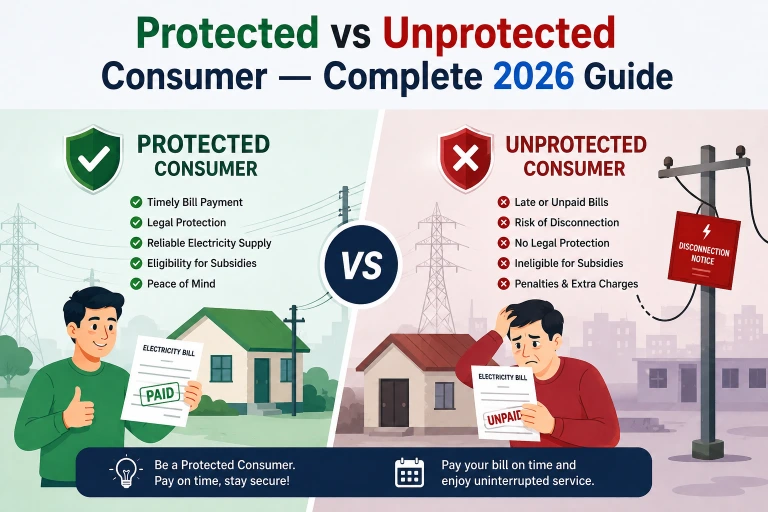
A protected electricity consumer is a domestic residential customer whose 6-month rolling average consumption is 200 kWh or less. The federal government provides a subsidy on this category — you pay heavily subsidized tariff rates, and the government compensates the distribution company for the difference.
Protected status is designed to make electricity affordable for lower-income households that use electricity modestly. In South Punjab, where a large portion of the population lives in smaller homes with limited appliances, this classification covers millions of connections.
Protected tariff rates (2026):
| Block | Rate per kWh |
|---|---|
| 1 – 50 kWh | Rs. 5.00 |
| 51 – 100 kWh | Rs. 7.77 |
| 101 – 200 kWh | Rs. 14.00 |
Fixed charge: Rs. 75/month (single-phase)
What is an Unprotected Consumer?
An unprotected consumer is a domestic residential customer whose consumption exceeded 200 kWh in any of the last 6 months. When this happens, you are moved to the unprotected tariff — and you stay there for a full 6 billing cycles, even if your consumption drops back below 200 kWh in all those subsequent months.
The unprotected tariff is significantly higher because there is no government subsidy. You pay the full cost-reflective rate.
Unprotected tariff rates (2026):
| Block | Rate per kWh |
|---|---|
| 1 – 100 kWh | Rs. 22.00 |
| 101 – 200 kWh | Rs. 27.00 |
| 201 – 300 kWh | Rs. 36.00 |
| 301 – 700 kWh | Rs. 45.00 |
| Above 700 kWh | Rs. 68.00 |
What is a Lifeline Consumer?
A lifeline consumer is a sub-category within protected — households that consistently consume 50 kWh or less per month. This covers very low-income rural households with minimal electricity use.
Lifeline tariff:
| Consumption | Rate per kWh |
|---|---|
| 1 – 50 kWh | Rs. 3.95 |
Lifeline consumers are also exempt from GST and pay no fixed charges. Their minimum monthly bill is approximately Rs. 197.50.
The Real Cost Difference — A Side-by-Side Comparison
This is where most people are shocked. Here is the same household at different consumption levels:
| Monthly consumption | Status | Energy charge | Estimated total bill |
|---|---|---|---|
| 150 kWh | Protected | Rs. 1,488 | ~Rs. 2,200 |
| 195 kWh | Protected | Rs. 2,010 | ~Rs. 3,000 |
| 200 kWh | Protected | Rs. 2,122 | ~Rs. 3,150 |
| 201 kWh | Unprotected | Rs. 4,427 | ~Rs. 6,500 |
| 205 kWh | Unprotected | Rs. 4,535 | ~Rs. 6,700 |
| 250 kWh | Unprotected | Rs. 6,350 | ~Rs. 9,200 |
The jump from 200 to 201 kWh adds approximately Rs. 2,300 in energy charges alone — Rs. 3,300+ in total bill including taxes. This is the 200-unit trap.
How Do You Lose Protected Status?
You lose protected status the moment your consumption in any single billing month exceeds 200 kWh. The system is automatic — no warning is given.
Once you cross 200 kWh in a month, you are placed on unprotected tariff for the next 6 billing months, regardless of how low your consumption is in those months.
This means one hot month in July where you ran the AC heavily and used 220 kWh can cost you protected status through December — 6 months of significantly higher bills.
How Do You Regain Protected Status?
After 6 consecutive months of your consumption staying at or below 200 kWh, you automatically return to protected tariff. The system recalculates your 6-month rolling average at the end of each billing cycle.
There is no manual application required to regain protected status — it is automatic when the rolling average qualification is met.
However, it is worth checking your bill after 6 months to confirm the rate has switched back. If you appear to still be on unprotected rates despite 6 months of low consumption, file a reclassification complaint.
How to Check Your Current Status
Your current protected/unprotected classification is shown on your electricity bill:
- Look for the Consumer Type or Tariff field on the detail section of your bill
- It will show: A-1 (Protected) or A-1 (Unprotected)
- You can also check via the online bill viewer — enter your reference number and look at the consumer details section
If you believe your classification is wrong, compare your last 6 months of consumption (available in your bill history) against the 200 kWh average threshold.
Practical Tips to Stay Protected
Staying below 200 kWh in South Punjab's summer is genuinely challenging — temperatures regularly reach 45°C in Multan and surrounding districts. Here is what actually works:
Monitor your meter weekly in summer. Do not wait for the bill. Check your physical meter every 7 days and calculate your running monthly total. If you are at 140 kWh on day 20 of your billing cycle, you have approximately 60 kWh left — roughly 2 hours of AC per day for the remaining 10 days.
Set your AC to 26°C minimum. Each degree below 26°C increases power consumption by 6 to 10%. Going from 20°C to 26°C in a 1.5-ton inverter AC saves approximately 30 to 40 kWh per month.
Use ACs during off-peak hours. Run the AC from 11 PM to 7 AM when temperatures are cooler and you need less compressor time to reach your target temperature. Your billing cycle consumption is based on total kWh — not when you used them — but less compressor work = fewer kWh.
Turn off geysers in summer. An electric geyser uses approximately 2 kWh per use. During summer, cold water is adequate. Eliminating geyser use saves 40 to 60 kWh per month in many households.
Replace remaining incandescent bulbs. A single 100W incandescent bulb running 8 hours per day adds 24 kWh per month. Replace it with a 12W LED and the same usage adds 2.88 kWh. If you have 10 such bulbs, the difference is 212 kWh vs 25 kWh per month from lighting alone.
Unplug standby appliances. TVs, chargers, and microwave ovens in standby mode collectively draw 5 to 15 watts continuously. Over 30 days, this can add 4 to 11 kWh.
Check for meter issues. If your consumption appears higher than your appliance use can explain, request a meter test through your subdivision office. A fast meter adds phantom consumption to every bill.
What Happens if You Believe You Were Wrongly Classified as Unprotected?
If you believe you should be protected based on your 6-month average but your bill shows unprotected status:
- Pull up your last 6 months of bills from the bill history tool
- Calculate your 6-month average consumption
- If the average is 200 kWh or less, you have grounds for a reclassification complaint
- File through the CCMS complaint portal — select "Billing Category Error" or "Consumer Reclassification"
- Attach your 6-month bill history as supporting documents
If the reclassification is confirmed, the excess billed amounts are typically credited against future bills rather than refunded in cash.
Protected Status and Solar Panels
After the December 2025 net billing policy change, consumers with solar panels export excess generation to the grid and receive credits. If your net consumption after solar credits is 200 kWh or less per month on average, you should qualify for protected status on the net consumption.
This is an evolving area — if your solar-connected bill is not reflecting protected rates that your net consumption should qualify for, raise it through the complaint process and reference the December 2025 net billing policy.
Full details: Net Metering 2026 guide.
Frequently Asked Questions — Protected vs Unprotected
How do I know if I am a protected consumer?
Check your electricity bill — the consumer type or tariff field will say "A-1 (Protected)" or "A-1 (Unprotected)." You can also check by entering your reference number in the bill checker on this site and looking at the consumer details.
If I cross 200 kWh just once, how long do I stay unprotected?
6 billing months — approximately 6 months from the month you crossed the threshold. Your rolling average is recalculated each month, and you return to protected status automatically once 6 consecutive months of sub-200 kWh consumption are on record.
Can I apply to get protected status back faster?
No. Protected status is determined entirely by your 6-month rolling average consumption — it is automatic and calculated by the billing system. There is no application to accelerate the return.
What if my average is below 200 kWh but I am still charged as unprotected?
File a reclassification complaint with your subdivision office or through the CCMS portal. Provide your 6-month consumption history as evidence. This type of complaint is typically resolved within 15 working days.
Does protected status apply to commercial connections?
No. Protected/unprotected status only applies to Tariff A-1 domestic residential connections. Commercial (B), Industrial (C), and Agricultural (D) tariffs do not have this classification.
Is the 200 kWh threshold the same everywhere in Pakistan?
Yes. The 200 kWh monthly average threshold for protected status is set by NEPRA and applies uniformly across all DISCOs in Pakistan.
Does protected status affect FPA charges?
Protected consumers pay FPA on fewer units (since they consume less), so the absolute FPA cost is lower. The per-unit FPA rate announced by NEPRA is the same for all consumer categories — only the total units consumed determines the total FPA charged.
Last updated: August 2026
Bill calculator — see your rate · Tariff rates 2026 · Bill history · File a complaint